The Breguet twice-tolling clock
A Gentleman in MoscowThe Breguet twice-tolling clock is a family heirloom and a working chronometer in the life of Count Alexander Ilyich Rostov. Made to order for his father, it measures the day with extraordinary precision and sounds at noon and midnight. The clock does more than mark passing hours: its regularity gives the Count’s routines a framework, while its chimes gather attention around moments of transition, from a weekly appointment to the delayed opening of a Christmas present.
Identity and Physical Form
The clock was commissioned from the venerable firm of Breguet for the Count’s father. Its appearance makes its precision tangible. A white enamel face, about the circumference of a grapefruit, sits above a lapis lazuli body that slopes from top to base. Inside, jeweled workings were cut by craftsmen whose reputation rested on their commitment to accuracy. The description joins ornament to function: this is a treasured possession, but also a mechanism whose finely made parts keep time audibly and exactly.
The clock enters the narrative as one of the objects the Count removes from his trunk and restores to its proper place on the desk. He takes it out alongside two bottles of brandy, after first setting down a photograph of the Delegation; his grandmother’s opera glasses follow. The sequence places the clock within a collection of inherited and personal belongings, rather than presenting it as an isolated instrument. Its place on the desk also makes it available to the Count as he reads and keeps track of the day.
Precision and the Count’s Daily Routine
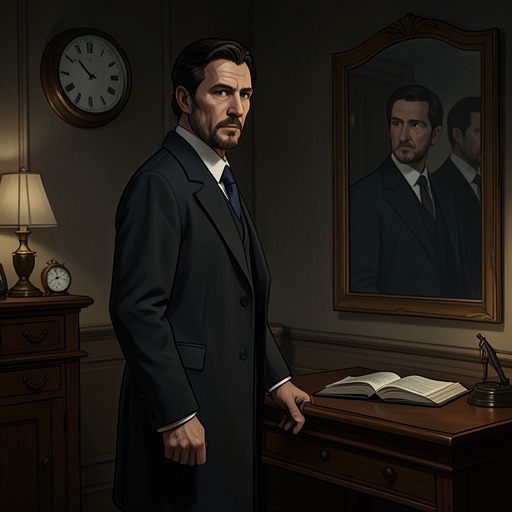
While reading Montaigne’s essays, the Count repeatedly glances at the clock, losing track of how many times he has done so. The narration’s uncertainty about his glances contrasts with the clock’s exactness. As he proceeds through an essay crowded with Plato, Aristotle, Cicero, and the Emperor Maximilian, he can hear every tick. The clock registers the time down to the second: the account follows one tick at 10:20:56 with the next at 10:20:57. Its precision is not merely claimed through its craftsmanship; the reading scene makes its measured sound part of the Count’s experience of time passing.
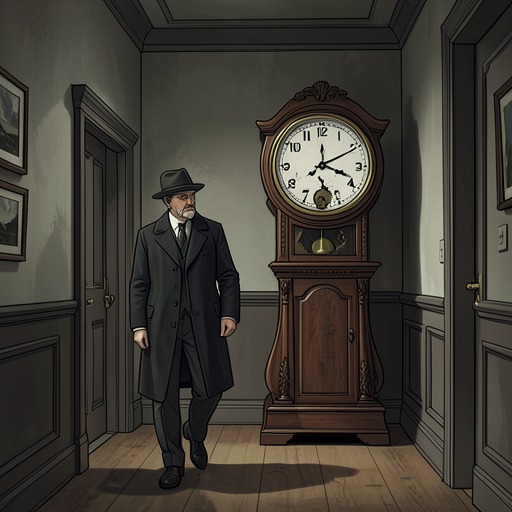
At noon, the mechanism turns exact measurement into a public signal within the Count’s room. The long-striding minute hand catches up with its bowlegged counterpart at the top of the dial. Springs loosen, wheels spin, and a miniature hammer falls, beginning the clock’s dulcet chimes. The sound interrupts the Count’s reading: his chair’s front feet drop to the floor, and Montaigne’s book turns twice in the air before landing on the bedcovers. The interruption has an immediate consequence. By the fourth chime the Count is rounding the belfry stairs; by the eighth he is passing through the lobby toward his weekly appointment with Yaroslav Yaroslavl, the Metropol Hotel’s barber. The clock’s signal thus moves him from private reading into the hotel’s scheduled life.
Midnight, Restraint, and Anticipation
At Christmas, the same instrument helps the Count make waiting into a deliberate practice. According to the clock, it is only eleven when he sits with port and a copy of A Christmas Carol, leaving Nina’s beautifully wrapped gift within reach. He waits for the midnight chime instead of opening it at once. This restraint recalls his childhood discipline: as a boy, he could march past the closed drawing-room doors before Christmas without giving in to curiosity, because experience had taught him that waiting preserved the season’s splendor.
The memory is specific. On Christmas Eve, his father would eventually give the signal, allowing the Count and Helena to pull open the doors and see a twelve-foot spruce lit from trunk to tip, garlands, oranges from Seville, and candies from Vienna. A gift hidden under the tree might be a wooden sword for defending ramparts or a lantern for exploring a mummy’s tomb. In adulthood, the clock’s midnight chime gives the Count a way to repeat that childhood pattern of anticipation. He does not pull the dark green bow on Nina’s gift until the twelfth and final chime. When he lifts the lid, he finds another box inside, wrapped in yellow and tied with another dark green bow. The clock marks the boundary between waiting and discovery, while the nested present extends the suspense beyond that boundary.
Inheritance and Recurrence
The clock’s chimes also accompany a toast whose scope reaches beyond the room. When it strikes twelve, even Mikhail Fyodorovich (Mishka) sees the merit in another glass of wine. The company toasts the Grand Duke, Helena, the Countess, Russia, Idlehour, poetry, and pacing, among other facets of life. In that scene the clock’s hour supplies a shared occasion: its signal gathers private affection, national belonging, and appreciation of ordinary pleasures into one ritual.
Across these moments, the clock is at once a crafted inheritance, a practical timekeeper, and a structure for repeated acts of attention. The Count hears its ticks while reading, moves at its noon chimes toward a standing appointment, and submits the opening of Nina’s gift to its midnight sequence. Its exact workings contrast with the vagaries of attention and the uncertainties of what waits inside a box, yet they do not eliminate anticipation. Instead, by making hours and chimes dependable, the clock gives the Count a dependable form in which to wait, remember, and proceed.